Unless the rifle is used for short range shooting, as hunting deer in the woods
of West Virginia where shots over 50 yards are unusual, I suggest floating the
barrel and relieving the action. This is especially true for wooden rifle
stocks but can also be justified for synthetics, as neither are completely
stable under varying conditions.
The barrel channel and action area should be sufficiently larger than the
running diameter of the barrel and action to not allow stock moisture or
resident chemicals to cause the stock to warp enough to stress the barreled
action under any shooting condition.
The following procedure specifies the absolute minimum clearance between barrel
and channel. You can increase the specified barrel channel clearance to about
0.07 inch, just slightly greater than 1/16
th
inch, if you like.
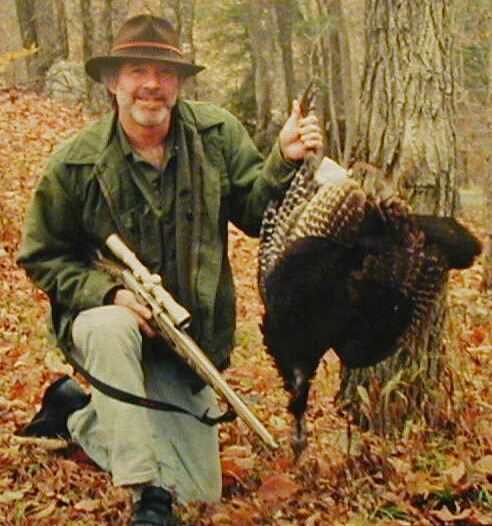
picture compliments of my Mannlicher style Ruger 10/22 and Simmons 4X scope
Floating and properly bedding a rifle pays off when needed. I held high on
this turkey aiming at center of neck expecting bullet to drop into heart/lung
area. I misjudged distance and hit the turkey where I aimed - 63 yards.
Don't ask me to do it again.
Floating the barreled action involves relieving all stress points and
potential stress points to all metal parts of the firearm. The barrel will
have no less than 0.05 inch clearance of stock and greater, up to about 0.07
inch, is better. The action, bolt handle and trigger assembly will have
approximately 0.02 inch clearance. The magazine should have a bit more, say
0.03 inch but can be greater, since it is capable of movement non-relative to
action. At a minimum a short section from front of magazine box to just past
recoil lug will be
glass bedded
.
Pillar bedding
is recommended for all wooden stock rifles subject to anything more than short
range shooting.
If you are working with a semi-inletted stock complete
action
and
trigger guard
inletting before floating the barrel. It may also be wise to not fashion the
exterior of forearm until barrel channel has been widened. This will ensure
plenty of wood for forearm is left.
Find something
cylindrical
to use as a sanding form. Including sand paper, it must be less in diameter
than the barrel is at forend tip. If too large it may cut the top of barrel
channel back too far leaving an unsightly gap. You will also need a small
sanding block
. A gum eraser should work well. Use the finest grit paper practical
working down to finer grits as the work progresses
Find some good plastic adhesive tape. Electrical or plumbers tape will do. If
you do not know the thickness of the tape, cut small lengths. Stack a few
together and measure thickness with a caliper or micrometer until you find the
number of layers needed to achieve 0.05 inch thickness. Cut one short piece of
tape. Wrap it around barrel about one inch forward of forend tip. Remove
barreled action from rifle stock. Set magazine, bolt, guard bolts and trigger
guard aside. They will not be needed for some time. We will tape the bottom
half of the barrel circumference to increase its horizontal diameter by 0.05
inch. On the bottom of barrel run one piece of tape from front of recoil lug
to the tape band you applied just forward of forend tip. If the tape is not
wide enough to cover half the circumference of the barrel another strip or two
will have to be run adjacent to it. Uniformly add layers of tape until 0.05
inch has been added to barrel from front of recoil lug to forend tip. The tape
should conform to the contour of the barrel. The barrel channel will be
expanded to allow taped barrel to seat in stock, at which time the channel will
be 0.05 inch deeper at all points than before.
Using the cylindrical sanding form deepen the barrel channel bottom and sides
without allowing sand paper to touch the tops of channel. Use the small
sanding block for expanding the tops of channel and take care to retain its
original contour. Angle the sanding block slightly into the channel as you run
it the length of channel. This will help keep the drop into channel sharp and
crisp. Periodically check fit with barreled action. Check fit more often as
more wood is removed. Wood lose seems to occur more easily at forend tip so
take it slow at that area or an unsightly gap will occur. The gaps can be
greater than 0.05 inch in areas of the channel that will not be seen and
it may help precision. Do not allow gaps that will be seen to be non-uniform
in width. When barreled action will seat without friction remove tape. With
rifle assembled check appearance. Disassemble and touch up wood that does not
conform to contour.
Using the sanding block sand action inlet until you can slip a paper business
card between stock and action from front of receiver to tang . Do not remove
wood from bedding of action (where guard bolts attach). That should be done
during the glass bedding procedure. Likewise remove wood around areas
of magazine and trigger assembly. Remove just enough wood around trigger
guard/floor plate inlet so that with one piece of electrical tape wrapped
tightly around trigger guard the guard will fit snugly into inlet. Do not
remove wood from trigger guard bedding (that which it fastens against when
assembled). With rifle assembled apply a very thin even coat of inletting
black to bolt handle. Close bolt to check for handle touching wood. If so
remove high spots until handle touches no wood when dropped into closed
position.
When finished
seal
the sanded areas or
glass
bed
the stock before sealing. It is advisable to glass a short area from front of
receiver to just past recoil lug. This will relieve the action from supporting
the barrel.