First, precision and accuracy are not the same. A rifle grouping 1/4
MOA
is very precise for a firearm. If that 1/4 MOA rifle puts groups off
the aiming point it is not accurate. Rifle precision is a measure of how close
it will hit to the same point it had before. Rifle accuracy is hitting the
aiming point. Equally though, it is true that if you are shooting for groups
and do not wish to destroy the aiming point but rather have the shots hit
somewhere else on the target the rifle is accurate if it does what you wish.
All of the above assumes, of course, that no blame can be proven on the
operator of said rifle.
For the purpose of determining rifle precision I will discuss only two methods.
The 'extreme' or 'maximum spread' method is the usual and quickest method used
by most of us while in the field. It is not accurate in fairly determining the
performance of a rifle but becomes a less inaccurate method as group size
decreases. For very tight groups it is a good method of measure because the
distinction between it and the 'average group radius' diminishes. The 'average
group radius' method is the best and most difficult I know of in determining
rifle precision. Determining average group radius involves time consuming
measurements and calculations in order to determine center of group and then
average shot placement relative to that center. It is a highly accurate means
of calculating rifle precision.
77 Yard Target
calculations are compliments of
RSI Shooting Lab Software
Using the Maximum Spread Method the above 3 shot grouping measures 0.70 MOA;
the Average Group Radius is 0.33 MOA.
Average Group Radius tells us how far from center of group we can expect the
shot to be. Maximum Spread emphasizes the worse shot.
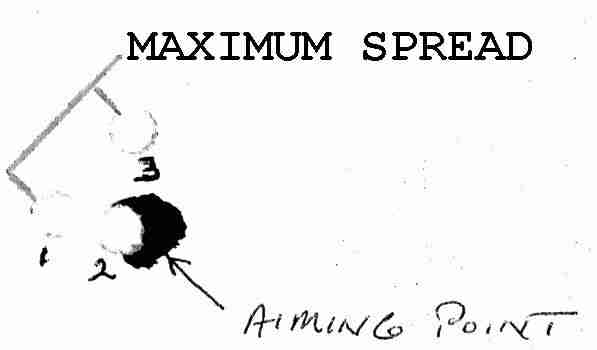
Maximum Spread
Sometimes referred to as 'extreme spread' maximum spread is a measure of the
distance between the centers of the two furthest shots within a group. It is
often thought to be a measure of the smallest circle the group will fit into.
This is misleading because the method does not distinguish between a tight
group that has a dissimilar shot and a not so tight group that is evenly
dispersed. The maximum spread method is acceptable for measuring tight groups
that do not have so called flyers and a reasonable measure for groups with all
its shots evenly dispersed. While in the field, I will usually rely on this
method for a quick idea of what the group is. If the group is interesting
enough or important enough I will later take the time to calculate the average
group radius.
Average Group Radius
First find the group center. Measure distance from center of group to center
of each shot. Average the distances. The result is the average group radius.
Double that would be the average diameter of the group but this figure is not
normally expressed. The average group radius is the average distance of the
center of shot to center of group.
To manually find the center of group draw a horizontal line through the center
of the lowest shot. Draw a vertical line through the center of the leftmost
shot. Measure and add the distances from the center of each shot to the
horizontal line. Average the sum of these distances by dividing it by the
number of shots. This gives the distance from the horizontal line to the
vertical center. Measure this distance from the horizontal line and mark that
location on the target. Measure and add the distances from the center of each
shot to the vertical line. Average the sum of these distances by dividing it
by the number of shots. This gives the distance from the vertical line to the
horizontal center. Place rule across vertical line and mark made at vertical
center. Measure the distance of the horizontal center from the vertical line
and mark it on the target. This last mark is the statistical center of the
group.
There is a ballistics program available that includes the unique feature of
entering a target grouping into the program. It will analyse the group and
give statistical data on it. Included in the analysis is the average
group radius. It is easy to enter. You press the target to the video screen
and click on each bullet hole with the mouse. You can also scan the target in.
There is a feature the software includes to calibrate the aspect ratio of the
video input so that the distances in both horizontal and vertical directions
are correct. The software can be found at
Recreational Software Inc.
and is the software used to analyse the above target.
A further discussion on measuring rifle precision is provided by selecting
'Measuring Targets Tech. Article' at
Tech. Articles.